
Commodity Logic Ruins Luxury
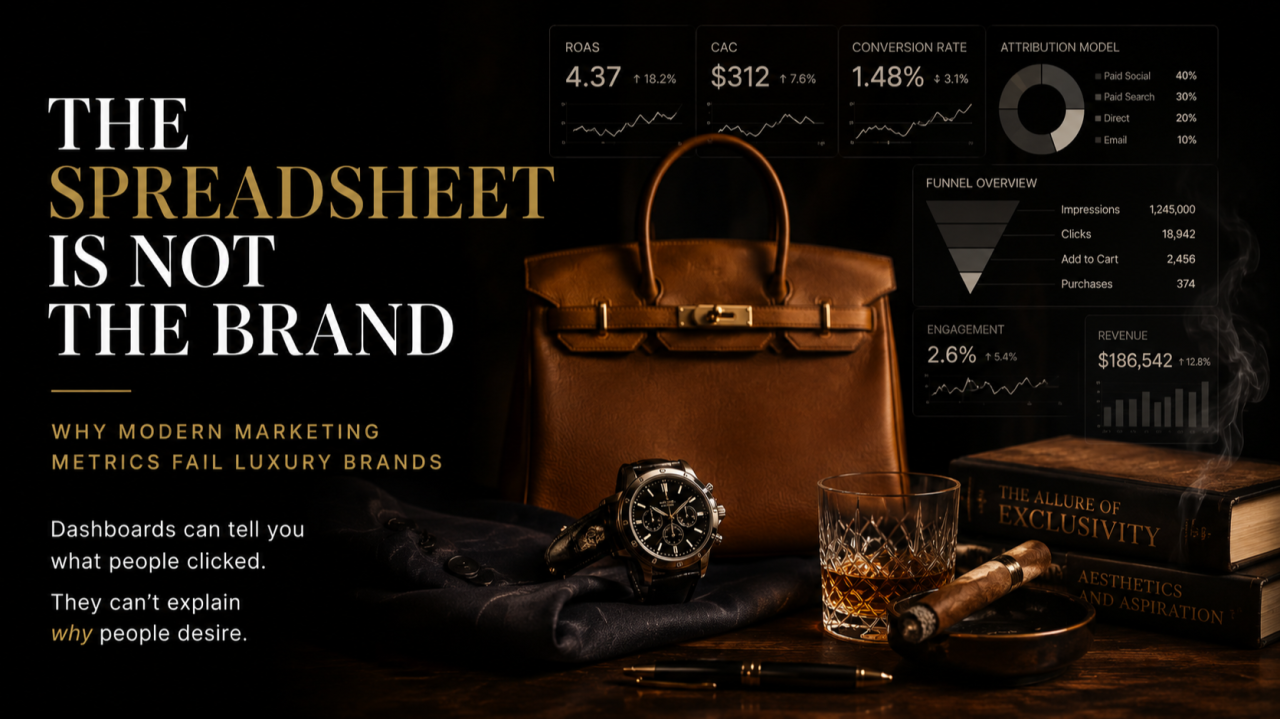
One of the biggest mistakes executives make is believing that marketing dashboards are measuring reality.
ROAS (Return on Advertising Spend), KPIs (Key Performance Indicators), CAC (Customer Acquisition Cost), attribution models, engagement metrics, and conversion paths all create the illusion of scientific precision around purchasing behavior that is often emotional, social, psychological, aesthetic, and cultural in nature.
Luxury businesses in particular are damaged by this mindset because the things that actually create value are often difficult — if not impossible — to quantify properly.
People do not buy luxury products, designer clothing, hospitality experiences, restaurants, hotel stays, nightlife, or cultural brands simply because they clicked an advertisement. They buy because of perception and aspiration; because of status signaling and because something feels socially meaningful. They buy because an environment feels elevated, because a brand communicates taste properly, because ownership or participation becomes part of identity, and because the experience itself signals belonging, discernment, status, or access.
A $50,000 Birkin bag, $10,000 Kiton sport coat, thousands for a cigar, or million dollar car does not fit neatly into traditional accounting logic.
The values attached to such things cannot be cleanly reduced to spreadsheets, attribution models, or conversion funnels. In many cases, consumer desire may actually be better understood through behavioral psychology and neuroscience than through conventional marketing dashboards alone.
The problem is that many — if not most — executives come from finance, operations, accounting, consulting, or business-school environments that are heavily quantitative and reductionist by nature. They are trained to seek certainty through measurable variables, models, dashboards, quarterly reporting structures, and optimization systems, so they naturally begin interpreting marketing primarily through a financial and operational lens.
Even more importantly, they tend to hire other people like themselves — people who speak the same analytical language and reinforce the same worldview and workflows. Over time, entire corporate hierarchies can become populated by left-brained “numbers people” who are highly skilled at optimization yet fundamentally disconnected from the emotional and cultural mechanics of affluent consumer behavior.
Everything becomes about attribution, efficiency, conversion percentages, acquisition cost, media spend, funnel optimization, views, impressions, and engagement statistics detached from emotional quality or cultural impact.
Meanwhile, the deeper drivers of luxury demand are rooted in psychology, sociology, anthropology, symbolism, aesthetics, tribal behavior, social perception, and even biology — precisely the kinds of things modern corporate structures increasingly struggle to measure.
I see this routinely. For example, a certain top luxury clothing retailer in Philadelphia endlessly promotes sales, financing options, operational conveniences, and transactional messaging while the imagery, copywriting, and creative direction remain emotionally flat and visually uninspiring. Their homepage emphasizes “free shipping on orders over $750,” payment plans, and operational details like "open 7 days" rather than communicating the emotional world, heritage, aspiration, craftsmanship, or lifestyle associated with the brands they carry.
This is a company with nearly a century of heritage representing some of the finest luxury labels in the world, yet the communication often feels closer to mid-tier ecommerce optimization than luxury storytelling. Tellingly, the owner-executives majored in finance related studies.
A major luxury timepiece seller in the Philadelphia suburbs has effectively created an artificial ceiling on its own brand positioning by marketing watches the way supermarkets market weekly specials. The focus is constantly on inventory, pricing, urgency, “deals,” and hyped-up transactional content rather than heritage, taste, aspiration, or the lifestyle associated with fine watchmaking. Timepieces costing hundreds of thousands of dollars are presented with the same tone and cadence used to market consumer electronics upgrades. Here too the CEO came out of the financial industry.
The examples are endless.
The irony is that affluent consumers themselves often buy emotionally first and rationalize intellectually afterward. A person may spend six figures on a watch, hotel, jacket, restaurant, membership club, or nightlife experience not because of pure utility, but because it reinforces identity, aspiration, exclusivity, nostalgia, fantasy, status, or social positioning.
And yet modern corporate structures increasingly dismiss these factors because they are difficult to quantify cleanly inside a quarterly report.
A beautiful campaign that elevates perception for years may be considered a failure because it did not produce immediate measurable conversions. Meanwhile, a discount-driven retargeting campaign that simply harvests existing demand gets celebrated because the dashboard claims the ROAS was strong.
Much of modern attribution is also borderline fictional. Someone may discover a brand through photography, hear about it privately from friends, encounter it repeatedly in real life, gradually develop aspiration over time, and see it associated with the right people and environments — only later clicking a paid advertisement before making a purchase. Then the advertising platform claims credit for the sale.
Meta, Google, TikTok, and other advertising platforms all have incentives to present themselves as indispensable revenue engines. In many cases they are simply capturing demand that was created elsewhere through brand building, cultural positioning, social proof, environment, word-of-mouth, and long-term perception management.
Luxury historically understood this far better. The great maisons were not built primarily through performance marketing optimization. They were built through image stewardship, atmosphere, exclusivity, consistency, aesthetic discipline, storytelling, and carefully managed social perception over long periods of time — long before modern social media existed.
Today, many prestige brands are undermining themselves by applying commodity-marketing logic to businesses built on aspiration and emotional desire. The obsession with measurable activity has caused companies to undervalue taste, atmosphere, cultural intelligence, restraint, design quality, scarcity, emotional resonance, prestige, social composition, and experiential cohesion — even though these are often the very things affluent customers are actually paying for.
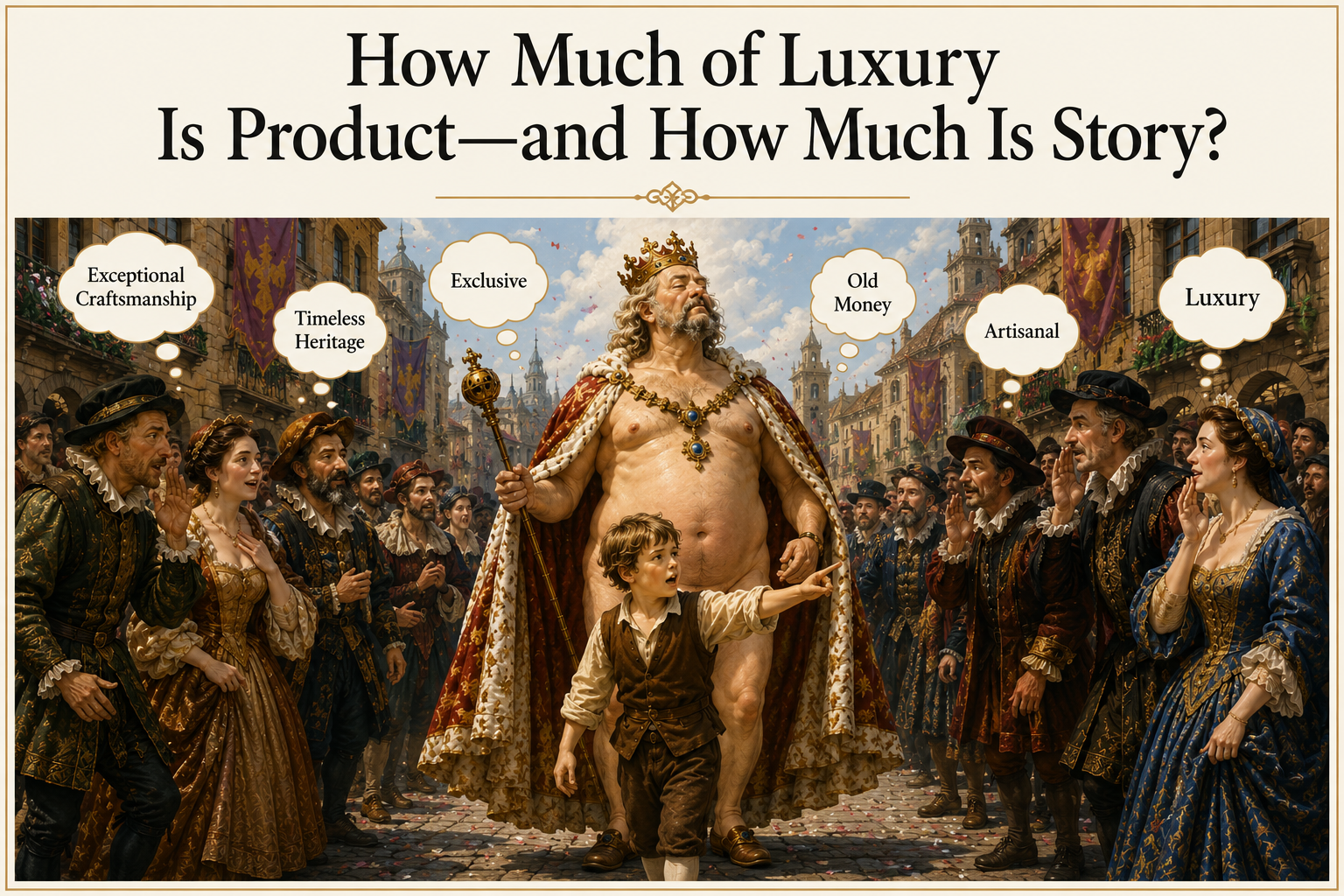
Luxury has never functioned purely as commerce. It functions as psychology, symbolism, theater, identity formation, aspiration, and social signaling.
The great luxury brands in history understood this intuitively. They understood that desire cannot always be engineered through optimization models, growth hacks, dashboards, quarterly metrics, and endless transactional messaging. Sometimes value is created precisely through what cannot be easily measured: mystique, taste, aspiration, cultural positioning, and emotional resonance accumulated slowly over time.
A dashboard can tell you what people clicked, what people viewed, and what people purchased, but it can never fully explain why people desire.
FOMO'Clock (Fear Of Missing Out on the Clock)
Just a few weeks ago, nobody on Earth was walking around thinking:
“You know what I really want? A plastic pocket watch on a lanyard — and I'll be happy to pay several thousand dollars for it.”
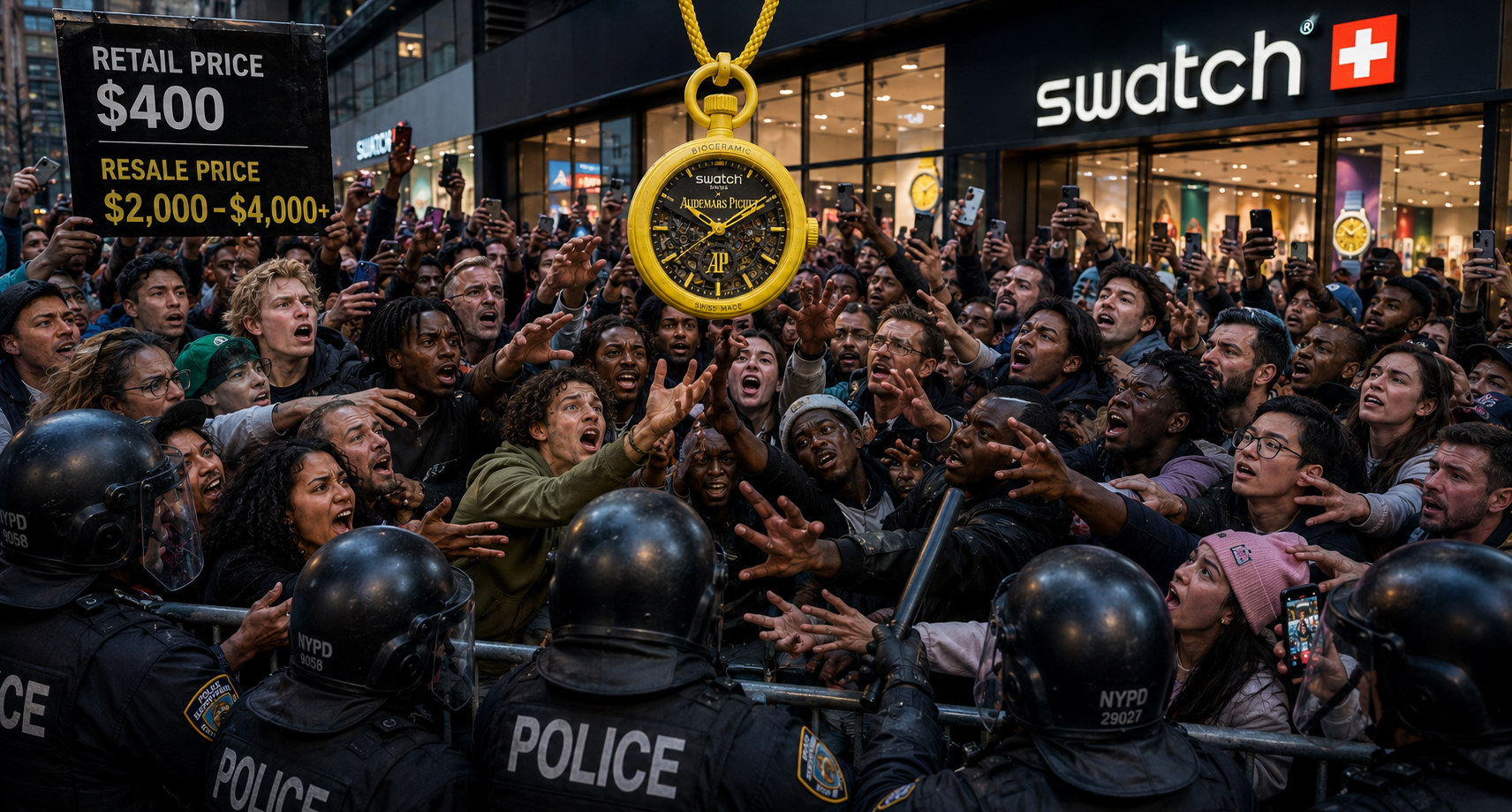
Yet suddenly people were camping outside stores, scuffling in crowds, rioting, and paying absurd resale prices for exactly that. Buyers on the resell market are happily paying thousands for the plastic novelty timepiece, made on a machine assembly line in an unlimited edition, and hardly different from a $12 coach's stopwatch. Yet many people value it on par with preowned Rolex, or even a new Omega, IWC, or Longines.
That alone tells you this phenomenon has very little to do with the object itself.
The recent Swatch x Audemars Piguet launch may have looked like a watch story, but it was really a story about modern psychology, status hunger, manufactured scarcity, and herd behavior.
Many people camped outside stores for five nights. Scuffles broke out. Linecutters invaded. Police pepper sprayed and swung truncheons. All for a shot to buy a $400 watch which could be immediately flipped for several thousand dollars.
The obvious question is: If demand is that high, why doesn’t Swatch simply raise the price and capture that market value themselves, rather than leave the spread to flippers? If Swatch priced the watch at the current market price of a couple thousand dollars, the riots and shortages would end immediately. But so would their news cycle.
The chaos is the marketing.
Luxury brands learned long ago that frenzy creates desirability. Scarcity creates perceived importance. Viral lines outside stores signal cultural relevance. The spectacle itself becomes part of the product.
This is not really about horology.
Many of the younger buyers likely know little about Audemars Piguet history, mechanical movements, finishing techniques, or even traditional watch culture. Viral social media posts show that many teens and twenty-somethings, if not most, struggle to read time on a conventional analog dial. Yet they desperately want the thing.
Why?
Because what they are truly buying is not a watch, but symbolic proximity to prestige and social status.
The AP name represents exclusivity, wealth, insider access, taste, and status. The Swatch collaboration offers a temporary “entry ticket” into that world for a few hundred dollars. Not ownership of true haute horlogerie, but participation in its image.
That is extraordinarily powerful psychologically, and we’ve seen versions of this phenomenon before, across time and cultures:
Tulip Mania
Beanie Babies
Supreme drops
Sneaker culture
Rolex waitlists
Birkin bags
NFTs
Meme stocks
Cryptocurrency frenzies
In every case, collective desire itself becomes the source of value.
Once crowds form, resale prices spike, influencers post videos, and news crews arrive, people interpret the demand as evidence that the object possesses importance beyond its material reality, and the product becomes social proof.
This is what philosopher René Girard described as mimetic desire: people wanting things because other people want them. But as my old friend and client, eminent investor Bruce Berkowitz often says: "Ignore the crowd." Trends and asset prices fueled my hysteria don't last and rationality returns to the mean.
Clever brand strategists deeply understand this mob mentality.
Social media has accelerated the phenomenon dramatically because platforms reward emotional contagion, envy, urgency, and FOMO (fear of missing out). A calm product launch does not trend online. Riots and 10X returns on product flips do.
Ironically, the object itself often becomes secondary.
A plastic watch, a digital token, a handbag, or a sneaker can suddenly command irrational prices because the item is functioning less as a utility and more as a cultural signal.
In many ways, we are watching the transformation of luxury from connoisseurship into algorithmic spectacle.
Historically, luxury markets were built around craftsmanship, heritage, engineering, rarity, and cultivated taste. Increasingly, however, many purchases are driven by visibility, virality, resale speculation, and identity performance.
The watch is no longer merely worn. It is posted.
The irony is that Audemars Piguet itself built its reputation over generations through exceptional craftsmanship and refinement. Yet in the modern attention economy, even elite luxury houses now participate in the same behavioral mechanics that drive sneaker drops and NFT hype cycles.
The Swatch x AP frenzy is not irrational chaos at the edges of consumer culture -- it is modern consumer culture, and designed that way. Time will tell how long the craze lasts.
DID YOU KNOW… The story behind Louboutin's red soles?

Most of you ladies are probably familiar with designer Christian Louboutin – and might even own a pair or two of his sumptuous shoes. The red leather soles on his high heels are his ultimate trademark, but how did he first think of including them onto his designs? While many might think that Louboutin was inspired by his childhood cabaret passion, there’s actually a little bit more to the story.
Click here to read more
Americans Snap Up Teslas, Bentleys, Lamborghinis as the Luxury-Auto Market Booms
More Americans are opting to buy luxury vehicles than ever before, a shift fueled by cash-rich buyers who were able to bank savings during the pandemic and growing wealth among shoppers in the upper-income brackets.
READ WALL ST JOURNAL ARTICLE HERE

Luxury Real Estate Trends for 2021
With affluent consumers making health-driven lifestyle choices amid the COVID-19 pandemic that will continue to shape the luxury real estate market and fuel growth as long as inventory holds out.
CLICK HERE TO READ ARTICLE
Members Only Model is Helping Restaurants, Luxury Travel Service
Subscriptions are fast becoming a way for pandemic-hit industries to get enough cash flow to hang on. For these purveyors, locking in clients with a recurring fee brings much-needed cash flow and stability in uncertain times, while consumers get a trustworthy partner in a familiar business model.
READ ARTICLE HERE
New site for Athena
Lanzara Studio recently produced AthenaRipka.com for singer-songwriter Athena.

Think Tank: How Luxury Brands Can Stay Ahead in the Age of Amazon
By Jason Grunberg for WWD
“During an earnings call in 2016, Jean-Jacques Guiony, the chief financial officer of LVMH — the luxury conglomerate whose brands include Louis Vuitton, Dior and Bulgari — said, “there is no way we can do business with them.” By “them,” Guiony meant Amazon, a company he believed to be the antithesis of what a luxury retail experience should be. Three years later, all three of those brands have their own Amazon stores. As do Chanel, Gucci and Tiffany & Co.”
Read article here
How Luxury Brands Remain Relevant To Millenials And Gen Z
By Jeff Fromm, for Forbes
"What we are observing today is a new paradigm: to successfully engage Millennials and Gen Z consumers, brands have to act in an inclusive, engaging and open manner. This requires a great deal of flexibility in communications, tone of voice, social media behavior. It all starts from within. Instead of asking themselves how to sell to these customers, brands should try and become “friends” with those new generations of consumers, participate in their lives through relevant channels and speak their language."
Read article here
Fashion Houses Leave Their Mark On Luxury Real Estate
From Versace to Armani, interiors by high-end brands can be found worldwide.
Read article here
Luxury Brands Are Becoming Big Players In The E-Commerce Game
By Tom Popomaronis for Forbes.com