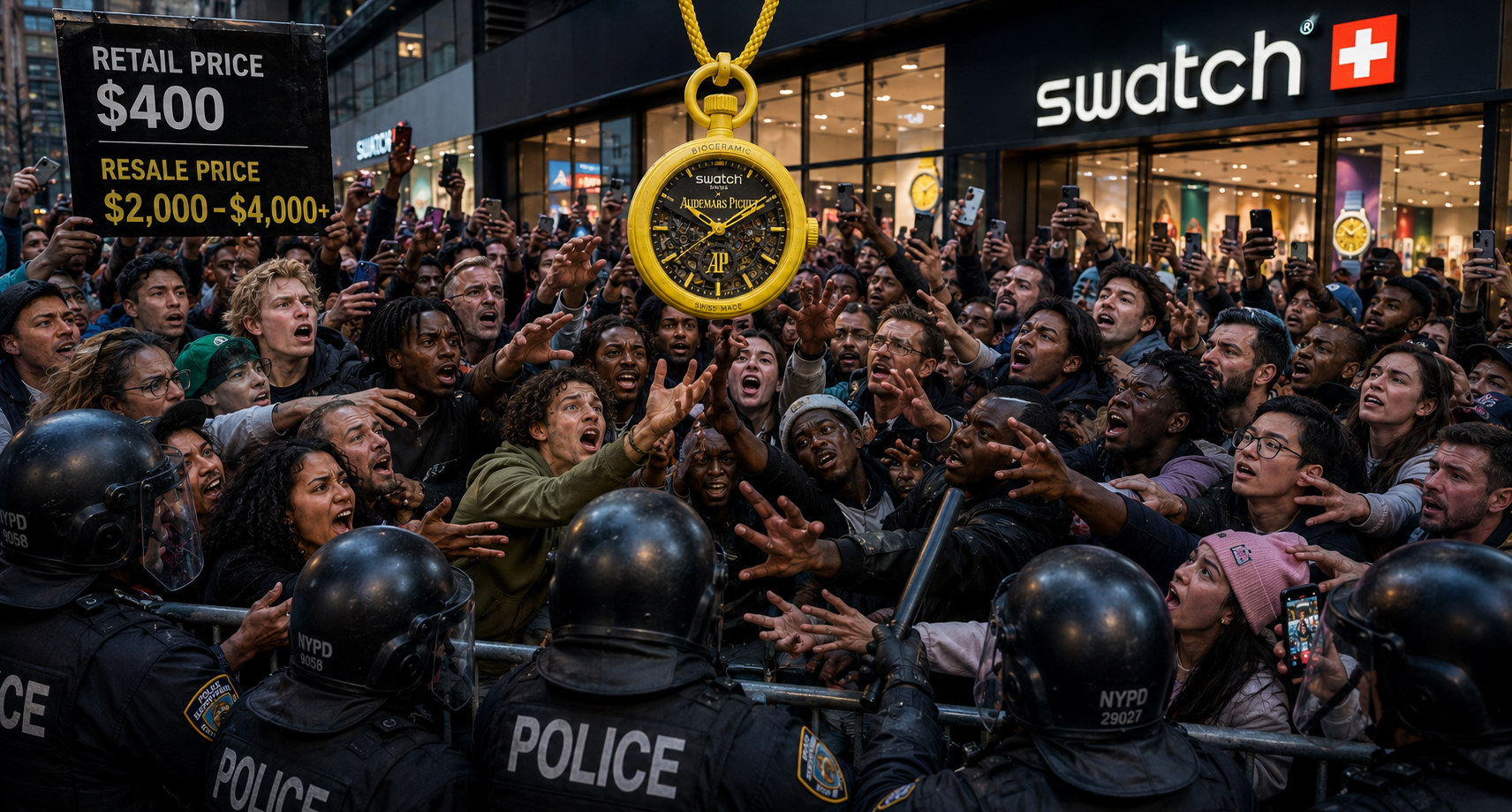
Just a few weeks ago, nobody on Earth was walking around thinking:
“You know what I really want? A plastic pocket watch on a lanyard — and I'll be happy to pay several thousand dollars for it.”
Yet suddenly people were camping outside stores, scuffling in crowds, rioting, and paying absurd resale prices for exactly that. Buyers on the resell market are happily paying thousands for the plastic novelty timepiece, made on a machine assembly line in an unlimited edition, and hardly different from a $12 coach's stopwatch. Yet many people value it on par with preowned Rolex, or even a new Omega, IWC, or Longines.
That alone tells you this phenomenon has very little to do with the object itself.
The recent Swatch x Audemars Piguet launch may have looked like a watch story, but it was really a story about modern psychology, status hunger, manufactured scarcity, and herd behavior.
Many people camped outside stores for five nights. Scuffles broke out. Linecutters invaded. Police pepper sprayed and swung truncheons. All for a shot to buy a $400 watch which could be immediately flipped for several thousand dollars.
The obvious question is: If demand is that high, why doesn’t Swatch simply raise the price and capture that market value themselves, rather than leave the spread to flippers? If Swatch priced the watch at the current market price of a couple thousand dollars, the riots and shortages would end immediately. But so would their news cycle.
The chaos is the marketing.
Luxury brands learned long ago that frenzy creates desirability. Scarcity creates perceived importance. Viral lines outside stores signal cultural relevance. The spectacle itself becomes part of the product.
This is not really about horology.
Many of the younger buyers likely know little about Audemars Piguet history, mechanical movements, finishing techniques, or even traditional watch culture. Viral social media posts show that many teens and twenty-somethings, if not most, struggle to read time on a conventional analog dial. Yet they desperately want the thing.
Why?
Because what they are truly buying is not a watch, but symbolic proximity to prestige and social status.
The AP name represents exclusivity, wealth, insider access, taste, and status. The Swatch collaboration offers a temporary “entry ticket” into that world for a few hundred dollars. Not ownership of true haute horlogerie, but participation in its image.
That is extraordinarily powerful psychologically, and we’ve seen versions of this phenomenon before, across time and cultures:
Tulip Mania
Beanie Babies
Supreme drops
Sneaker culture
Rolex waitlists
Birkin bags
NFTs
Meme stocks
Cryptocurrency frenzies
In every case, collective desire itself becomes the source of value.
Once crowds form, resale prices spike, influencers post videos, and news crews arrive, people interpret the demand as evidence that the object possesses importance beyond its material reality, and the product becomes social proof.
This is what philosopher René Girard described as mimetic desire: people wanting things because other people want them. But as my old friend and client, eminent investor Bruce Berkowitz often says: "Ignore the crowd." Trends and asset prices fueled my hysteria don't last and rationality returns to the mean.
Clever brand strategists deeply understand this mob mentality.
Social media has accelerated the phenomenon dramatically because platforms reward emotional contagion, envy, urgency, and FOMO (fear of missing out). A calm product launch does not trend online. Riots and 10X returns on product flips do.
Ironically, the object itself often becomes secondary.
A plastic watch, a digital token, a handbag, or a sneaker can suddenly command irrational prices because the item is functioning less as a utility and more as a cultural signal.
In many ways, we are watching the transformation of luxury from connoisseurship into algorithmic spectacle.
Historically, luxury markets were built around craftsmanship, heritage, engineering, rarity, and cultivated taste. Increasingly, however, many purchases are driven by visibility, virality, resale speculation, and identity performance.
The watch is no longer merely worn. It is posted.
The irony is that Audemars Piguet itself built its reputation over generations through exceptional craftsmanship and refinement. Yet in the modern attention economy, even elite luxury houses now participate in the same behavioral mechanics that drive sneaker drops and NFT hype cycles.
The Swatch x AP frenzy is not irrational chaos at the edges of consumer culture -- it is modern consumer culture, and designed that way. Time will tell how long the craze lasts.