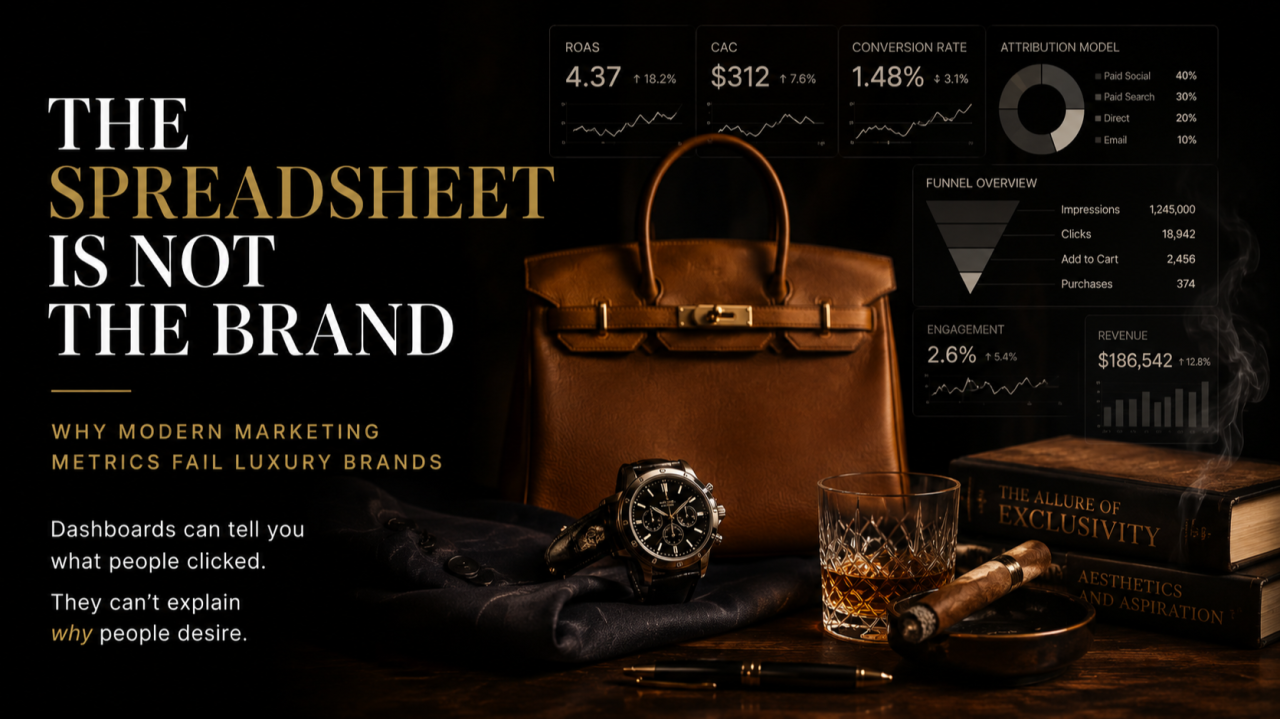
One of the biggest mistakes executives make is believing that marketing dashboards are measuring reality.
ROAS (Return on Advertising Spend), KPIs (Key Performance Indicators), CAC (Customer Acquisition Cost), attribution models, engagement metrics, and conversion paths all create the illusion of scientific precision around purchasing behavior that is often emotional, social, psychological, aesthetic, and cultural in nature.
Luxury businesses in particular are damaged by this mindset because the things that actually create value are often difficult — if not impossible — to quantify properly.
People do not buy luxury products, designer clothing, hospitality experiences, restaurants, hotel stays, nightlife, or cultural brands simply because they clicked an advertisement. They buy because of perception and aspiration; because of status signaling and because something feels socially meaningful. They buy because an environment feels elevated, because a brand communicates taste properly, because ownership or participation becomes part of identity, and because the experience itself signals belonging, discernment, status, or access.
A $50,000 Birkin bag, $10,000 Kiton sport coat, thousands for a cigar, or million dollar car does not fit neatly into traditional accounting logic.
The values attached to such things cannot be cleanly reduced to spreadsheets, attribution models, or conversion funnels. In many cases, consumer desire may actually be better understood through behavioral psychology and neuroscience than through conventional marketing dashboards alone.
The problem is that many — if not most — executives come from finance, operations, accounting, consulting, or business-school environments that are heavily quantitative and reductionist by nature. They are trained to seek certainty through measurable variables, models, dashboards, quarterly reporting structures, and optimization systems, so they naturally begin interpreting marketing primarily through a financial and operational lens.
Even more importantly, they tend to hire other people like themselves — people who speak the same analytical language and reinforce the same worldview and workflows. Over time, entire corporate hierarchies can become populated by left-brained “numbers people” who are highly skilled at optimization yet fundamentally disconnected from the emotional and cultural mechanics of affluent consumer behavior.
Everything becomes about attribution, efficiency, conversion percentages, acquisition cost, media spend, funnel optimization, views, impressions, and engagement statistics detached from emotional quality or cultural impact.
Meanwhile, the deeper drivers of luxury demand are rooted in psychology, sociology, anthropology, symbolism, aesthetics, tribal behavior, social perception, and even biology — precisely the kinds of things modern corporate structures increasingly struggle to measure.
I see this routinely. For example, a certain top luxury clothing retailer in Philadelphia endlessly promotes sales, financing options, operational conveniences, and transactional messaging while the imagery, copywriting, and creative direction remain emotionally flat and visually uninspiring. Their homepage emphasizes “free shipping on orders over $750,” payment plans, and operational details like "open 7 days" rather than communicating the emotional world, heritage, aspiration, craftsmanship, or lifestyle associated with the brands they carry.
This is a company with nearly a century of heritage representing some of the finest luxury labels in the world, yet the communication often feels closer to mid-tier ecommerce optimization than luxury storytelling. Tellingly, the owner-executives majored in finance related studies.
A major luxury timepiece seller in the Philadelphia suburbs has effectively created an artificial ceiling on its own brand positioning by marketing watches the way supermarkets market weekly specials. The focus is constantly on inventory, pricing, urgency, “deals,” and hyped-up transactional content rather than heritage, taste, aspiration, or the lifestyle associated with fine watchmaking. Timepieces costing hundreds of thousands of dollars are presented with the same tone and cadence used to market consumer electronics upgrades. Here too the CEO came out of the financial industry.
The examples are endless.
The irony is that affluent consumers themselves often buy emotionally first and rationalize intellectually afterward. A person may spend six figures on a watch, hotel, jacket, restaurant, membership club, or nightlife experience not because of pure utility, but because it reinforces identity, aspiration, exclusivity, nostalgia, fantasy, status, or social positioning.
And yet modern corporate structures increasingly dismiss these factors because they are difficult to quantify cleanly inside a quarterly report.
A beautiful campaign that elevates perception for years may be considered a failure because it did not produce immediate measurable conversions. Meanwhile, a discount-driven retargeting campaign that simply harvests existing demand gets celebrated because the dashboard claims the ROAS was strong.
Much of modern attribution is also borderline fictional. Someone may discover a brand through photography, hear about it privately from friends, encounter it repeatedly in real life, gradually develop aspiration over time, and see it associated with the right people and environments — only later clicking a paid advertisement before making a purchase. Then the advertising platform claims credit for the sale.
Meta, Google, TikTok, and other advertising platforms all have incentives to present themselves as indispensable revenue engines. In many cases they are simply capturing demand that was created elsewhere through brand building, cultural positioning, social proof, environment, word-of-mouth, and long-term perception management.
Luxury historically understood this far better. The great maisons were not built primarily through performance marketing optimization. They were built through image stewardship, atmosphere, exclusivity, consistency, aesthetic discipline, storytelling, and carefully managed social perception over long periods of time — long before modern social media existed.
Today, many prestige brands are undermining themselves by applying commodity-marketing logic to businesses built on aspiration and emotional desire. The obsession with measurable activity has caused companies to undervalue taste, atmosphere, cultural intelligence, restraint, design quality, scarcity, emotional resonance, prestige, social composition, and experiential cohesion — even though these are often the very things affluent customers are actually paying for.
Luxury has never functioned purely as commerce. It functions as psychology, symbolism, theater, identity formation, aspiration, and social signaling.
The great luxury brands in history understood this intuitively. They understood that desire cannot always be engineered through optimization models, growth hacks, dashboards, quarterly metrics, and endless transactional messaging. Sometimes value is created precisely through what cannot be easily measured: mystique, taste, aspiration, cultural positioning, and emotional resonance accumulated slowly over time.
A dashboard can tell you what people clicked, what people viewed, and what people purchased, but it can never fully explain why people desire.