One of the most fascinating marketing experiments in recent years was conducted not by a luxury house, but by Payless Shoes.
The company rented a pop-up retail space in a high-end Los Angeles mall, rebranded itself as "Palessi," invited fashion influencers and industry insiders, served champagne, and presented ordinary Payless shoes as exclusive designer products. Shoes that normally retailed for $20 to $40 were marked up to as much as $645 for the evening. Guests admired the styling, praised the quality, and in some cases happily paid prices many times higher than the shoes normally commanded. Payless later refunded the purchases and allowed buyers to keep the shoes.
The story generated headlines because it seemed amusing. Yet beneath the humor was an uncomfortable truth about luxury, branding, and perhaps human nature itself.
The shoes had not changed. The materials had not improved. No master craftsman had suddenly appeared in a workshop to elevate their construction. The only thing that changed was the context in which the products were presented and the story attached to them.
Most people like to believe they possess independent judgment. We imagine that we evaluate products, services, restaurants, hotels, wines, and even people based on objective merit. In reality, we are profoundly influenced by the opinions and signals surrounding us. Price, presentation, exclusivity, reputation, environment, and social validation often shape our perceptions long before we have had a chance to evaluate the thing itself.
Hans Christian Andersen understood this nearly two centuries ago.
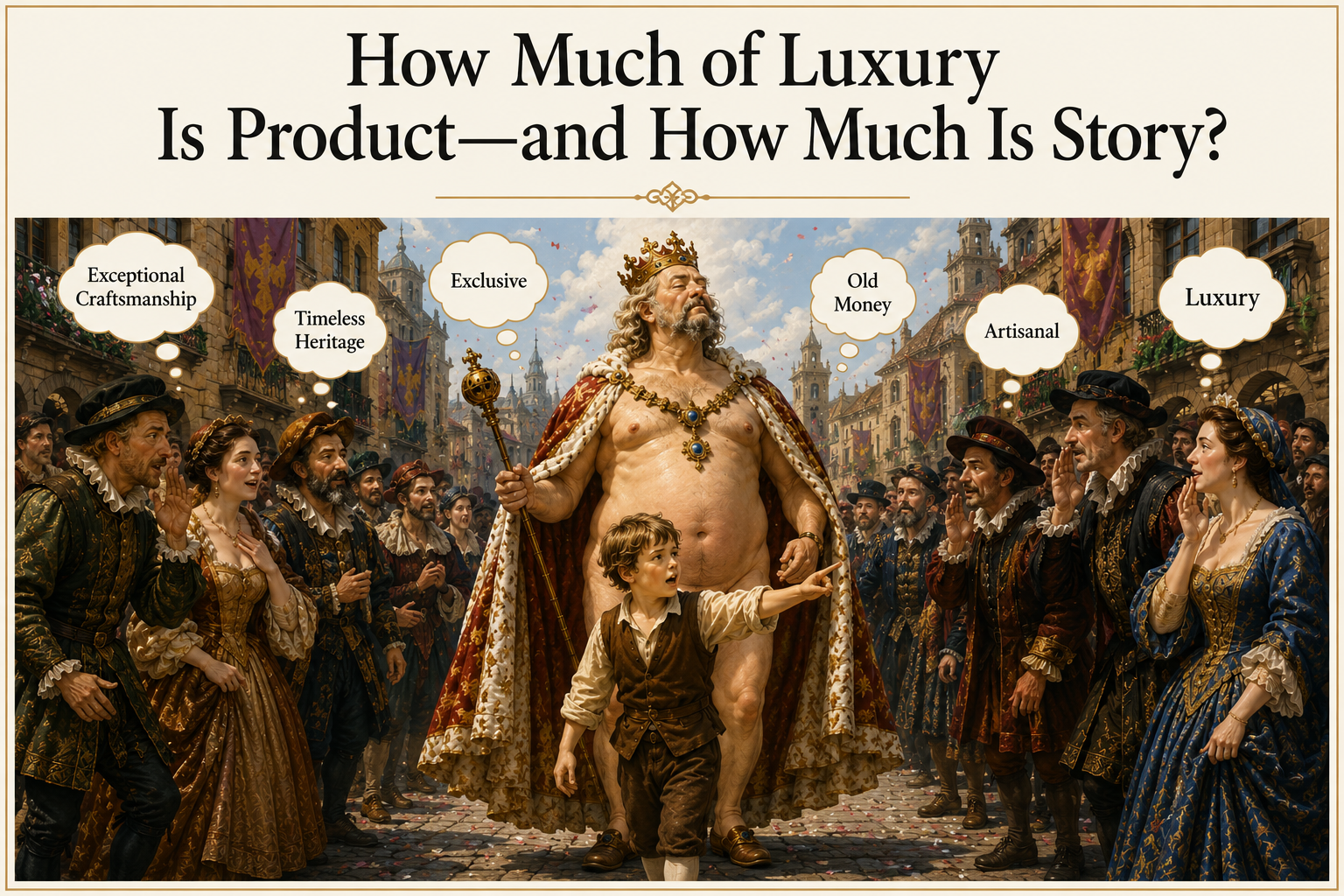
In The Emperor's New Clothes, an entire kingdom convinces itself that it sees magnificent garments that do not exist. The emperor wishes to appear sophisticated. His advisors wish to appear intelligent. The citizens wish to appear refined. Everyone participates in the illusion because everyone is taking cues from everyone else. The famous child who points out the obvious is not necessarily wiser than the adults. He is simply the only one looking directly at reality rather than at the reactions of the crowd.
Luxury branding often operates in the space between those two perspectives.
To be clear, I am not arguing that luxury itself is a fraud. Genuine craftsmanship exists. A handmade shoe is not the same as a mass-produced shoe. A hand-finished watch is not the same as a quartz movement assembled by machine. There are artisans, designers, and manufacturers creating objects of extraordinary quality, and they deserve recognition for their work.
What interests me is something else: how few consumers are actually equipped to distinguish quality from narrative.
Researchers have repeatedly found that people rate wine more highly when they believe it is expensive. In some experiments, the very same wine receives dramatically different reviews depending solely upon the price attached to the bottle. Under the hypnosis of branding, the master sommelier who's told he's drinking a $1000 Montrachet becomes giddy over what is actually a $5 wine packaged in a carton. The taster is not lying. He genuinely experiences the wine differently. Expectation alters perception, and even human biology.
The luxury industry has understood this for decades. The finest brands are not merely manufacturers of products; they are architects of perception. They know that consumers rarely buy a watch to know the time, a handbag to carry possessions, or a sports car to travel from one place to another. They are purchasing a story about themselves and their place in the world.
This is why luxury branding places such emphasis on atmosphere, heritage, packaging, photography, architecture, celebrity endorsement, scarcity, and ritual. These elements are often dismissed as superficial when, in reality, they are inseparable from the product itself. The physical object is only one component of a much larger experience designed to create meaning.
The lesson of the Payless experiment was not that luxury is fake. It was that meaning itself has value, and that most people struggle to separate the object from the narrative surrounding it. The lesson of The Emperor's New Clothes was much the same.
We like to imagine ourselves as the child in Andersen's story, immune to influence and capable of seeing things exactly as they are. More often, however, we are members of the crowd, looking to one another for cues about what deserves admiration.
Interestingly, the phenomenon works in reverse as well. Context can make an exceptional product appear mediocre.
Recently, someone posted an actual Monet painting on social media while claiming it was an AI-generated imitation of Monet's style. Commenters quickly criticized it as evidence of AI's inability to capture the master's spirit. The brushwork was wrong. The composition lacked feeling. The soul of the artist was absent.
The painter, of course, was Monet.
Nothing about the image had changed. Only the story attached to it.
That may be the most important lesson for marketers. People do not experience products objectively. They experience products through a framework of expectations, assumptions, reputations, and social signals. Change the framework, and you can dramatically change the experience.
The greatest luxury brands understand this. They recognize that people do not simply buy products. They buy stories, symbols, aspirations, and identities. In many cases, those intangible qualities become more valuable than the thing being sold.
Yet day after day I encounter companies focused almost entirely on the product itself while treating story, presentation, and positioning as secondary considerations.
The irony is that consumers often judge the story first and the product second.
Whether that makes us gullible or simply human is a question each reader can answer for himself.
-Josh